Suffolk Design
Festival 2026
Headline Partner:

On Thursday 24 September, the sold-out Suffolk Design Festival took over The Apex in Bury St Edmunds.
Our theme was Future Neighbourhoods. Not simply what future development might look like, but how it should feel, who it should serve and what we need to do differently to create places where people genuinely belong.
The Festival brought together people working across planning, architecture, landscape, development, housing, engineering, heritage, local government and education.
This was never going to be a beige conference.
There were challenging ideas, practical workshops, new connections, live drawing, a temporary woodland and the occasional unexpected Suffolk reference.
There was only one way to begin.
Alright Buh.
Resources and Links


Before we get into it… thank you
The Suffolk Design Festival was created through an extraordinary collective effort.
Thank you to every speaker, panellist, workshop host, marketplace exhibitor, sponsor and partner who gave their time, knowledge and support.
Thank you to The Apex team for helping us transform the venue, and to the brilliant volunteer team who welcomed people, managed registrations, supported workshops, answered questions, moved things around and kept the whole day running.
Quite simply, the Festival could not have happened without you.


The morning: culture, connection and profitable neighbourhoods
Culture is not the decoration at the end
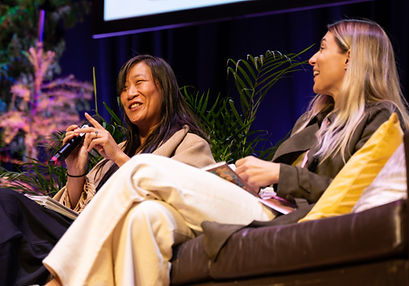
Wayne Hemingway MBE opened the Festival in conversation with Jayne Knight.
Drawing on work from Lowestoft to Blackburn, Salford, Margate and beyond, Wayne made the case for culture as a genuine placemaking tool, not something sprinkled onto a development once everything else has been decided.
Events and shared experiences can reveal the identity of a place, bring communities together, create confidence and begin to change how somewhere is seen. First Light Festival in Lowestoft provided a particularly fitting example of what can happen when local character, creativity and community are placed centre stage.
Wayne also challenged us to consider the everyday life of our neighbourhoods.
Are we creating places where children can be “free-range kids”? Are we designing out isolation? Are we listening to the people who want to dance, play and make things happen?
Or are we still creating places that look perfectly acceptable on a plan but do very little for the people living there?


Proximity matters
Sarah Allan, Head of Architecture and Urban Design at the Ministry of Housing, Communities and Local Government, explored how many of our systems remain hardwired around twentieth-century assumptions.
Her presentation focused on proximity: bringing people closer to services, nature and one another while carefully balancing privacy with connection.
Sarah encouraged us to understand neighbourhoods through distance, time and lived experience, not simply land-use diagrams and policy requirements. She also made the case for small projects, experimentation and community stewardship, recognising that successful places must continually adapt rather than remain frozen at the moment they are completed.
More homes, fewer cars—and more life
Cany Ash of Ash Sakula Architects then turned her attention to Profitable Neighbourhoods.
Her provocation was simple: why do so many new developments place cars front and centre when people are asking for connection, walkability and lower-carbon lifestyles?
Cany demonstrated how new neighbourhoods can grow from what is already present: a station, an old building, a mature tree, an established path, a stream or a story.
Anything, really, except another isolated field surrounded by roads and fences.
Using projects including Tibby’s Triangle in Southwold and The Malings in Newcastle, Cany showed that density can be beautiful, sociable and responsive to its setting. From “skinny ribbons” to “bellied streets,” she also reminded us that the early stages of masterplanning can be creative, interactive and even fun.
More homes and fewer cars need not mean less character. Done properly, they can mean more life.


Six workshops. Plenty of ways to see place differently.
The conversations moved beyond the main stage through two rounds of workshops held across The Apex and Bury St Edmunds.
The YES Approach to Engaging Young People
Participants examined a development proposal through the eyes of a child, using community, connectivity, climate and culture to question what was being designed, and who had been involved.
Bury St Edmunds: 1,000 Years in the Planning
A walk through the town revealed layers of change, heritage and planning, demonstrating how decisions made by different generations continue to shape Bury today.
Shade Suffolk: Designing for a Hotter Future
This session explored how trees, buildings, streets and public spaces must respond to rising temperatures, and why shade can no longer be treated as a pleasant optional extra.
Designing Healthy Places
Using local evidence and data, attendees considered how planning and design decisions can support healthier, more active lives.
Sense of Place: Nine Degrees of Awareness
People were invited to understand place through the senses, three dimensions and time. This involved drawing, observation, soil, rabbit hay and sawdust.
So, not your average conference workshop.
Behind the Scenes at The Apex and the Arc
Hopkins Architects led a tour exploring the transformation of Bury’s former cattle market, including the opportunities, constraints and sometimes difficult edge conditions created by major regeneration.
Apparently, attendees also discovered that Bury has a particularly posh Greggs. Local knowledge is important.


The afternoon: designing for women, girls and belonging
The afternoon began with Planning Future Neighbourhoods for Women and Girls.
Chaired by Katie Fowler, the panel brought together Charlotte Morphet, Marina Milosev, Susan Leadbetter and Mei-Yee Man Oram.
This was not a conversation about installing a few more lights and considering the job done.
The panel explored gender-informed design, lived experience, intersectionality, evidence and the importance of embedding inclusion at the beginning of the planning and design process.
One line raised during the discussion captured the issue particularly powerfully:
“Prisons are secure, but it doesn’t mean they are safe.”
A route may appear short and convenient on a desktop assessment. Experience it as a woman, a child, a disabled person or someone travelling alone after dark and it may tell a very different story.
People do not experience places as spreadsheets. Good design requires observation, listening and a willingness to understand experiences beyond our own.
Change is inevitable. Poor quality is not.


Marie Smith, Director of Planning and Growth at West Suffolk Council, closed the main-stage programme by asking: What makes a place loved?
Using Bury St Edmunds and the transformation of its former cattle market as a local example, Marie challenged the idea that placemaking is simply a choice between old and new.
Places have always changed. The real question is how we shape that change so the next generation inherits something better.
Marie encouraged us to think for 1,000 years, design at “door distance” and recognise that emotion is a function. How somewhere makes people feel is part of what it does.
Her three questions for every major decision gave the day a fitting final challenge:
-
Will people care about this place?
-
Will it become better with time?
-
Will more people feel they belong here?


The marketplace.
The Festival marketplace brought together 15 organisations working across Suffolk’s built and natural environment.
It provided somewhere to continue conversations, discover new work, meet future collaborators and catch up with familiar faces. For many attendees, those informal discussions were every bit as useful as the programmed sessions.
It also demonstrated one of Suffolk Design’s greatest strengths: bringing different professions and sectors into the same room.
Because good design is not one profession’s responsibility.
As one attendee put it:
“Good design is everyone’s agenda, not just architects.”


The Festival—drawn live
While the conversations unfolded, illustrator Chris Fenwick was capturing them in real time.
Ideas, quotations and connections from across the programme gradually became one large visual record of the day. Chris’s finished illustration managed to hold together everything from future neighbourhoods and inclusive design to local identity, a chicken and a teapot...obviously.
The illustration gives us something more than a record of who said what. It captures the character, energy and occasional chaos of a day filled with different voices and ideas.
Take a closer look and see which moments you remember.
Chris Fenwick - Chris Fenwick - Illustration, Graphic Recording and Facilitation


A temporary woodland with a lasting legacy
The Festival stage was designed to feel different.
Eleven living trees, Scots pines, larches and dawn redwoods, surrounded the speakers, creating a temporary Suffolk woodland inside The Apex.
They were not simply disposable stage dressing.
Following the Festival, several of the larger trees began their journey to community spaces across Suffolk, where they can be planted, cared for and enjoyed for years to come.
A small part of the Festival that will, quite literally, continue to grow.


The next generation of Suffolk Design
The Festival also marked the launch of the Suffolk Design Emerging Professionals Network.
This new multidisciplinary network will bring together people at the beginning of their careers across planning, architecture, landscape, engineering, development and related professions.
Its strength will come from those different perspectives, and from creating the relationships that rarely happen when each profession remains within its own circle.
With the support of Suffolk Design and the growing Suffolk Design Collective, the network will provide opportunities to connect, learn, share ideas and help influence the future of place across the county.
Interested in being part of it? Register your interest and help shape what comes next.
Where next?
The response to the Festival has been extraordinary.
People described it as creative, generous, thought-provoking and welcoming. Others called it “food for the brain and soul” and an opportunity to remember what they love about working with places and communities.
More importantly, people left talking about what they would do differently:
-
Push harder for shade and cooling measures
-
Make explicit reference to women and girls in planning discussions
-
Create places where children can move, play and develop independence
-
Treat culture as essential infrastructure
-
Engage a wider range of people, and act on what they say
-
Build connected neighbourhoods around existing places and services
-
Look beneath the surface to understand heritage, identity and memory
-
Design for belonging, not simply access
The Festival may have lasted one day, but it was never intended to be a one-day conversation.
Through the Suffolk Design Collective, our Suffolk Design Sessions and the Emerging Professionals Network, we will continue bringing people together to learn, challenge convention and support better outcomes across Suffolk.
The trees have found new homes. The sofas are off the stage. The lanyards have been packed away.
But the ideas, connections and challenges created during the Suffolk Design Festival are only just beginning.
For all the complexity involved in planning, design and development, Wayne perhaps gave us the simplest test of all:
We have a responsibility to leave this place better than we found it.
It really is as simple as that.